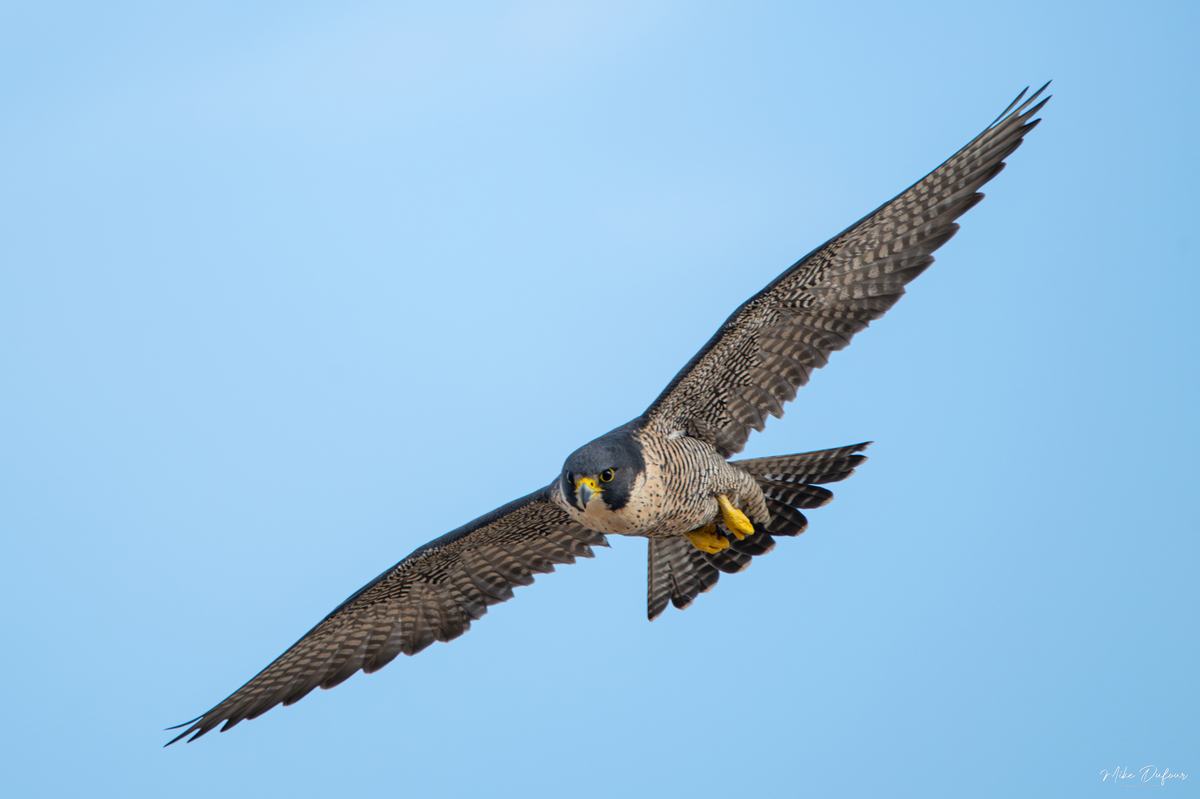
Peregrine Falcon
Australian Hobby
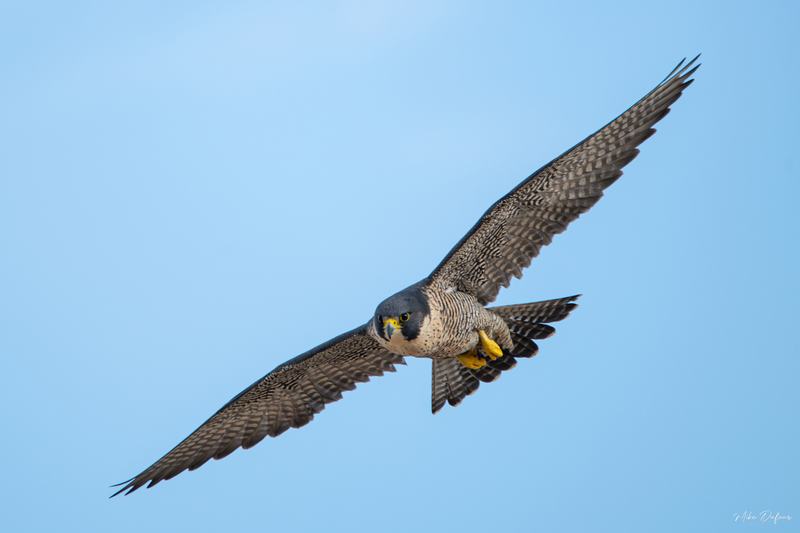 Click to enlarge image
CC BY-NC 4.0
Fast Facts
-
- IUCN Conservation Status
- LEAST CONCERN (LC)
-
Classification
- Genus
- Falco
- Species
- peregrinus
- Family
- Falconidae
- Order
- Falconiformes
- Class
- Aves
- Subphylum
- Vertebrata
- Phylum
- Chordata
- Kingdom
- Animalia
-
- Size Range
- 38 cm to 48 cm
The Peregrine Falcon is a geographically widespread species and can be found on all continents except Antarctica. They are a highly adaptable species and live in an incredibly wide range of habitats and climates - from arid tundras and deserts to wet tropical rainforests and everything in between. Artificial habitats, including urban environments, are also increasingly inhabited. The Peregrine Falcon is one of the fastest birds of prey, swooping down at speeds of up to 300 km/h.
Identification
The Peregrine Falcon is a powerfully built raptor (bird of prey) with blue-grey upperparts and cream to buff underparts. They have a slate-grey to black hood that extends down below the eyes and onto the cheek. The skin around the eyes (orbital ring) is a bright yellow-orange. The throat and upper breast are white, with the chest and underparts strongly barred. The feet of adults are bright yellow and bluish-green in juveniles. Females are typically larger than males.
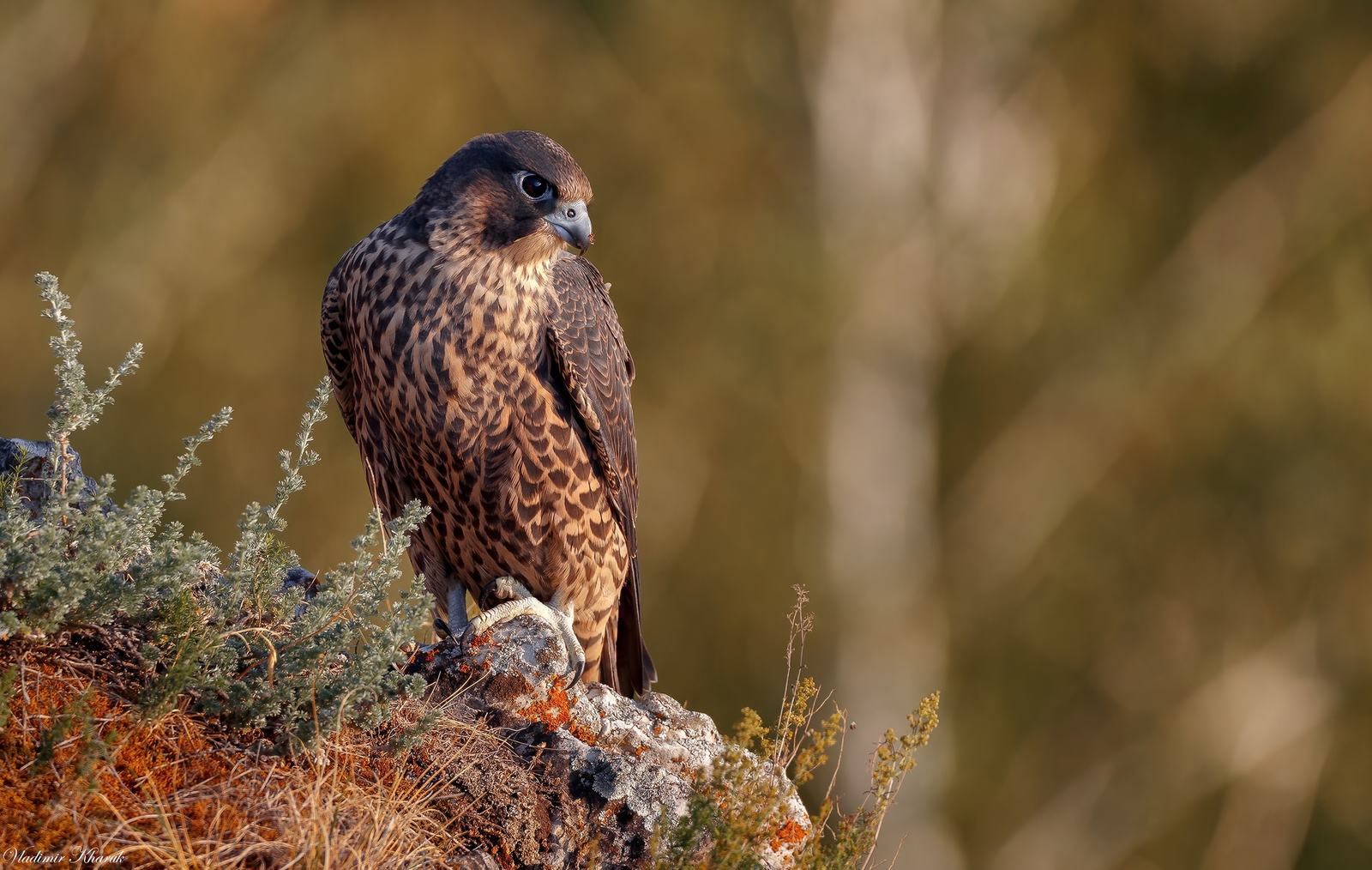
CC BY 4.0 Show more lines
The Peregrine Falcon closely resembles the Australian Hobby. The two species can be differentiated based on the following features:
- Patterning: Peregrine falcons feature dark-coloured horizontal barring, while Australian Hobbys have fine vertical striations (note that juveniles of both species have vertical streaking on the chest, however peregrines are typically more heavily streaked and may also feature spots).
- Colouring: the upperparts of adult Peregrines are cream to buff, whereas the Hobby is a rufous or rust-red colour.
- Hood: The Peregrine features a full, dark hood. The Hobby has a prominent malar stripe, or 'tear-drop', under the eye which forms a partial hood or facial mask. The Hobby also features a half-collar and is buffy-white on the hindneck.
- Orbital ring: yellow in adult peregrines and bluish-grey in the adult hobby.
- Underwing pattern: In flight, the Hobby features spotted underwings where peregrines are barred. The underwing coverts of the Hobby are a distinct rufous that contrasts with the darker coloured flight feathers.
- In flight: the Hobby features sharp, narrow wings and a slender tail, in contrast to the long, tapered wings and shorter tail of the Peregrine.
Habitat
The Peregrine Falcon is found in a wide variety of landscapes. This species has been documented living in wet tropical rainforests, moist lowlands, saltmarshes, open grassland, scrubland, tundra, deserts and mountain ranges. They can also be found in marine and coastal areas, mangroves and wetlands. Peregrines frequently inhabit artificial, human-built environments (i.e. cities and other urban areas).
Distribution
The Peregrine is found throughout Australia and the Pacific, parts of New Zealand and throughout Asia, Africa, Europe and the Americas.
Seasonality
Little is known about the movement of Peregrine Falcons in Australia. While adults are thought to be relatively sedentary, juveniles have been recorded dispersing hundreds of kilometres from their natal nest sites. The longest recorded movement of an Australian individual banded as a juvenile was 333km.
In the Americas, the movement of the Peregrine Falcon has been studied in greater detail. Individuals carrying satellite transmitters have been recorded spending winter in Central America and moving to the Canadian Arctic to breed. One individual covered a distance of over 14,500km between these two locations.
Feeding and diet
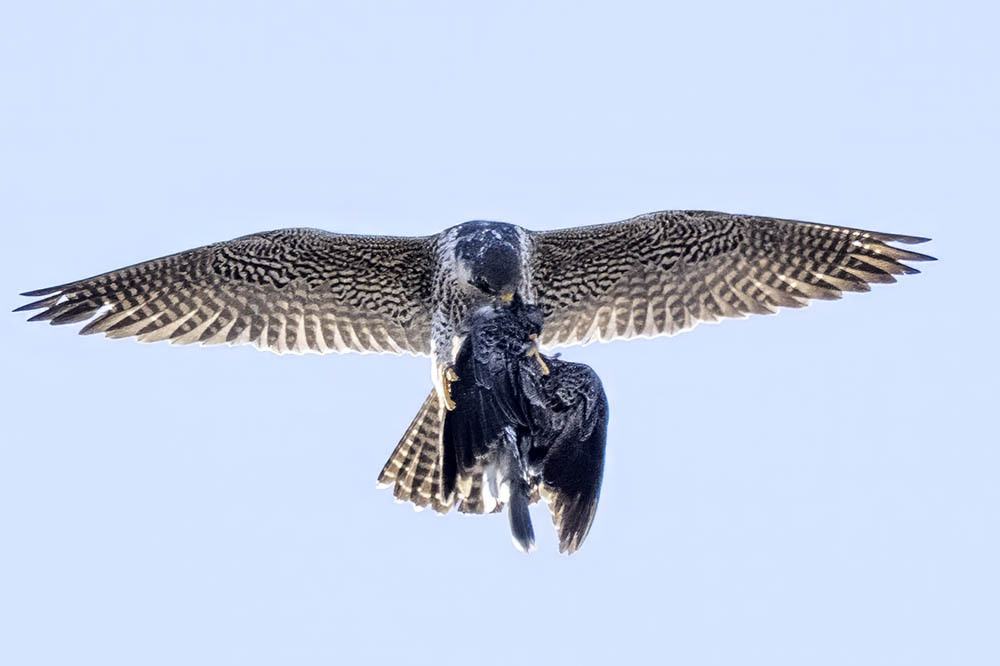
The Peregrine Falcon feeds on a wide variety of small to medium-sized birds, including pigeons, small parrots and passerines (perching birds) such as starlings, sparrows, swallows and finches. Small mammals like microbats, rabbits and rodents are also predated upon.
Peregrines are often seen climbing and soaring on air currents and thermals. Once prey has been spotted, the Peregrine climbs high above its prey and enters a stoop, plummeting towards its prey. Once within striking distance, prey is knocked out of the sky with incredible force and stunned before being carried off to a perch to be consumed. They will also wait from a perched position to pursue and catch prey.
Pairs have been known to hunt cooperatively during the breeding season, with one bird (usually the male) flushing a flock of birds while the other circles overhead to stoop and catch an individual.
CC BY-NC 4.0
Reproduction and life cycle
Breeding behaviours
Peregrine Falcons lay their eggs in a shallow depression or 'scrape' on a cliff ledge. While they do not build their own stick nests, Peregrines will reuse the old nests of other birds, including other raptors. They have also been known to use large tree hollows and when provided, nest boxes.
In the last two decades, Peregrines have increasingly taken to nesting in urbanised environments, such as on high ledges of tall buildings.
Both the male and female share parental duties, including incubating the eggs and providing food for the chicks. Juvenile Peregrine Falcons will disperse and cover large distances once fledged but frequently return to their natal home area to breed once mature.
Peregrine Falcons mate for life and maintain a home territory of 20 to 30 square kilometres throughout the year. The Peregrine Falcon has the broadest natural breeding distribution of any landbird.
- Breeding Season: August to December
- Clutch size: Two to four, usually three
- Incubation: 30 days
- Time in nest: 35 days
Communication
Loud, shrill, repeated: 'hek-ek-ek', with females lower-pitched than males.
Conservation and Human Impacts
The Peregrine Falcon suffered a devastating worldwide population decline in the 1950s-1970s due to the widespread use of pesticides, particularly DDT. This chemical accumulated in prey species before being consumed by Peregrines, which heavily impacted reproductive success. DDT primarily caused abnormally thin eggshells, leading to eggs being crushed in the nest. The Peregrine almost became extinct in some regions but successful conservation and recovery efforts saw the population bounce back in one of the most well-known wildlife conservation successes of the last century.
References
- BirdLife Australia (2023). Peregrine Falcon. Text before updates sourced from: Marchant, S. et al (eds) 1990-2006 Handbook of Australian, New Zealand and Antarctic Birds. Volume 1 to 7. Birdlife Australia.
- Debus, S., Olsen, J. and Larkin, C. 2019. Assessment of band recoveries for four Australian falcon species. Corella 43: 81-98.
- Morcombe, M. 2000. Field guide to Australian Birds. Steve Parish Publishing.
- Olsen, P. 1995. Australian Birds of Prey: the Biology and Conservation of Raptors. University of New South Wales Press, Sydney.
- Schodde, R. and Tideman, S.C. (eds) 1990. Reader's Digest Complete Book of Australian Birds (2nd Edition). Reader's Digest (Australia) Pty Ltd, Sydney.
- Seaton, R., Gilfedder, M. and Debus, S. 2019. Australian Birds of Prey in Flight. CSIRO Publishing Australia.
- Simpson, K and Day, N. 1999. Field guide to the birds of Australia, 6th Edition.Penguin Books, Australia.
- White, C.M., Clum, N. J., Cade, T. J. and Hunt, W. G. (2024). Peregrine Falcon (Falco peregrinus). In Birds of the World (S. M. Billerman and M. G. Smith, eds). Cornell Lab of Ornithology, Ithaca.